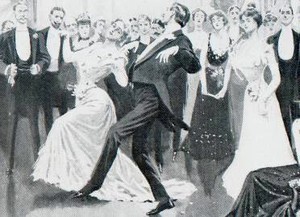
The Cakewalk was a dance developed from the "Prize Walks" held in the late 19th century, generally at get-togethers on slave plantations in the Southern United States. Alternative names for the original form of the dance were "Chalkline-Walk", and the "Walk-Around".
The following lists Professional and Amateur International Style Latin and Standard Champions of the World DanceSport Federation (WDSF).

Brooklyn Dancesport Club (BDSC) - ballroom dance studio , was created by 11 times United States National Champions Eugene Katsevman and Maria Manusova.

Zouk is a musical style originating from the Caribbean islands of Guadeloupe and Martinique and popularized by the French Antillean band Kassav' in the 1980s. Very rapid in tempo, the style lost ground in the 1980s due to the strong presence of Compas / kompa and kadans, the main music of the French Antilles. Today, zouk is the French Antilles compas (Kompa), also called zouk-love.
Brazilian zouk dance is a partner dance originating from Brazil. Also known as zouk-lambada, the dance is a descendant of lambada, the music & dance style that swept over the world like a storm in the late 1980's. Brazilian zouk is characterized by the dancers’ undulating bodies and the girls' flowing hair. Depending on the style of Brazilian zouk, you can see a close connection embrace and long graceful steps, strong hip movements, body isolations and upper-body torsions, wild spins and whip-like head movements. While the dance is often called sensual, it is not sexual or erotic. It is danced by people of all ages in night clubs, dance schools and events around the world!

The Brazilian Samba is a lively, rhythmical dance of Afro-Brazilian origin that originated from a dance known as the Maxixe.
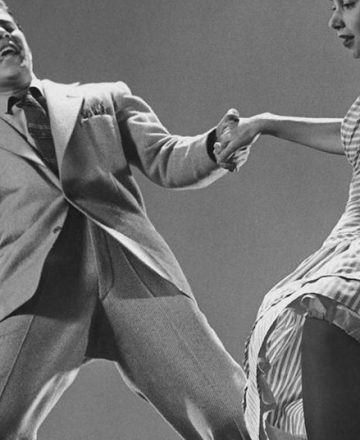
Lindy Hop evolved in the early 1930s. It is a dance of African American origin characterized by a high degree of physical vigor. It is characterized by an 8-count circular basic or "swing out" and has an emphasis on improvisation and the ability to easily adapt to include other steps in 8-count and 6-count rhythms. The name "Lindy Hop" is often attributed to "Shorty" George Snowden during an interaction with a reporter who asked him what kind of dance they were doing. Because Charles Lindbergh had just made his famous solo flight across the Atlantic Ocean, Shorty George is said to have replied, "the Lindy Hop." Whether it was Shorty George who coined the name is disputed by some writers, but, in any case, the name stuck. The Savoy Ballroom in Harlem was the home of the Lindy Hop. As its popularity increased, professional troupes were formed. These troupes toured the United States and Europe performing versions of the Lindy Hop.


The Boogie Woogie is a social and competitive dance that was originally inspired by American Rock 'n' Roll/Lindy Hop dancing of the 1950s, but gradually developed its own European style and personality. Boogie Woogie is a playful and improvised couple dance. The Boogie Woogie competitions are regulated by the World Rock'n'Roll Confederation which is a member of World DanceSport Federation (WDSF).

The Bolero is a genre of slow-tempo Latin music and its associated dance. There are Spanish and Cuban forms which are both significant and which have separate origins. The term is also used for some art music. In all its forms, the Bolero has been popular for over a century.
Latin-American Champions Under 21 Amateur Professional Ballroom Champions Under 21 Amateur Professional