East Coast Swing (ECS) is a form of social partner dance. It belongs to the group of swing dances. It is danced under fast swing music, including rock and roll and boogie-woogie.
Yerrington and Outland equated East Coast Swing to the New Yorker in 1961. Originally known as "Eastern Swing" by Arthur Murray Studios, the name East Coast Swing became more common between 1975 and 1980.

Danzon is a sequence dance, in which all danced together a set of figures. It is the official musical genre and dance of Cuba. Danzón is a slow, formal partner dance, requiring set footwork around syncopated beats, and incorporating elegant pauses while the couples stand listening to virtuoso instrumental passages, as characteristically played by a charanga or tipica ensemble. It is also an active musical form in Mexico, and is still much loved in Puerto Rico.
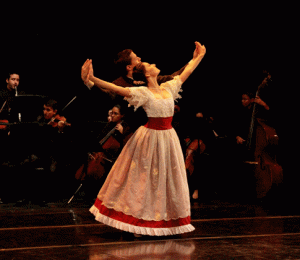
Contradanza is a 19th-century Cuban salon and popular dance and music genre often mistaken abroad as habanera, but which denotes Havana-style contradanza in addition to an earlier style of contradanza: namely, a Spanish line dance popular in the 18th and early 19th centuries thought to come from an older English "country dance" (thus the Spanish corruption of the name). It was Franco-Haitian slaves seeking refuge in Oriente in the 1790s, however, not the Spanish, who introduced the genre to island, in the form of the French contredanse.
Although rhythmically tame by contemporary Afro-Cuban standards, the contradanza was scandalously syncopated for its time because it represented one of the earliest obvious entrances of African rhythm into Cuban music salons which had until then been a venue for strictly European forms like waltzes, quadrilles and schottisches. Previously, European instruments, melodies and harmonies had worked their way into the musical practices of Cuban slaves, but no such reversal of musical influence had been so strong until the appearance of the contradanza.
While the Cuban contradanza was well-established by the turn of the 19th century, the earliest surviving example is "San Pascual Bailón," which dates from 1803.
West Coast Swing as a synonym for "Western swing" appears in a 1961 dance book, and was used in an advertisement by Skippy Blair in 1962 but wasn't incorporated into mainstream swing circles until the late 1960s. Blair credits Jim Bannister, editor of the Herald American newspaper in Downey, California, for suggesting the name "West Coast Swing".
is a social .

Wheelchair DanceSport is a partner dance competition and Dancesport where at least one of the dancers is in a wheelchair.

The Cha Cha Cha originated in Cuba in the early 1950s and refers to a style of ballroom dancing included in DanceSport categories of competition. The Cha Cha Cha can be danced in either the International Latin Style or the American Rhythm Style. In addition, this dance style is derived from the Rumba and the Mambo.
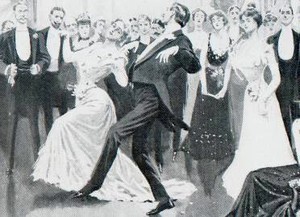
The Cakewalk was a dance developed from the "Prize Walks" held in the late 19th century, generally at get-togethers on slave plantations in the Southern United States. Alternative names for the original form of the dance were "Chalkline-Walk", and the "Walk-Around".

Brooklyn Dancesport Club (BDSC) - ballroom dance studio , was created by 11 times United States National Champions Eugene Katsevman and Maria Manusova.

The Brazilian Samba is a lively, rhythmical dance of Afro-Brazilian origin that originated from a dance known as the Maxixe.

Latin American Sequence Dance is a part of what is known as sequence dancing. Sequence dancing is a form of dance in which a preset pattern of movements is followed, usually to music which is also predetermined. Sequence dancing may include dances of many different styles. The term may include ballroom dances which move round the floor as well as line, square and circle dances.